
You mop the floor expecting it to look refreshed. Instead, once it dries, you notice a cloudy haze across the surface. It may look like:
- A white film in sunlight
- Dull reflection under overhead lights
- Patchy matte streaks
- A faint fog over dark hardwood
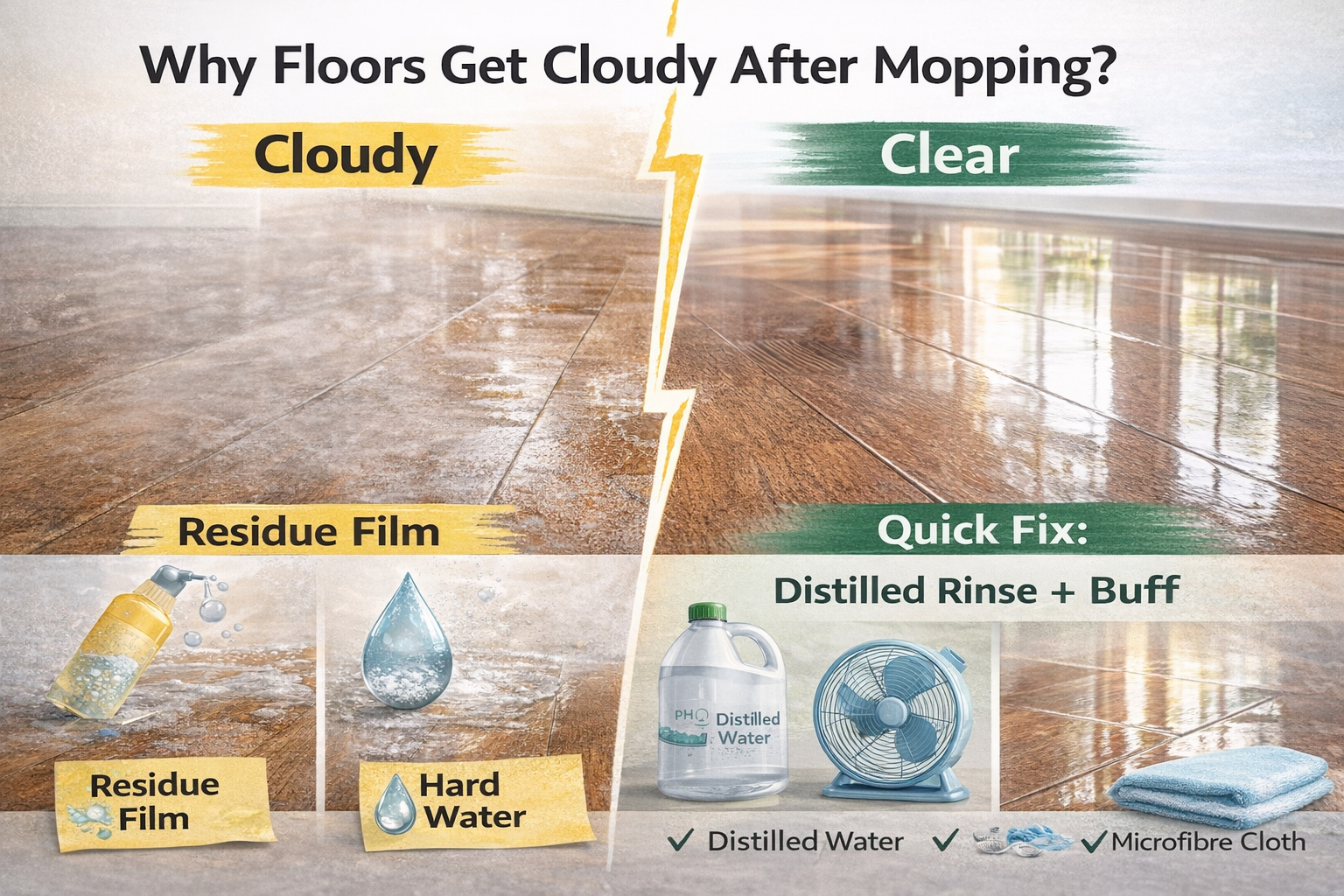
If you’re asking why floors get cloudy after mopping, the answer is almost always connected to what happens after water evaporates.
Cloudiness is rarely dirt. It’s usually residue, minerals, moisture imbalance — or in some cases, finish stress.
Let’s break it down clearly.
What “Cloudy” Actually Means
Cloudiness is an optical problem, not a texture problem. The floor may:
- Feel smooth
- Not feel sticky
- Not feel rough
But it looks unclear. That happens when light doesn’t reflect evenly. Instead of bouncing cleanly off the surface, it scatters. Scattering is caused by:
- Film buildup
- Mineral crystals
- Uneven drying
- Micro-abrasion in finish
If the surface feels textured instead of hazy, that’s a separate issue explained in our guide on why floors can feel slightly rough once they dry.
Cloudy floors are about light — not touch.
The Most Common Cause: Cleaner Residue
Most haze problems come from product overuse. Even if you follow label instructions, small over-concentration builds up over time.
Here’s what happens:
- Mop spreads diluted cleaner
- Water evaporates
- Surfactants and polymers remain
- Film forms
- Reflection becomes muted
This layer can be invisible until light hits at an angle.
Signs residue is the culprit:
- Floor looks shiny while wet
- Haze appears only after drying
- Buffing improves clarity
- Problem worsens over months
Hard Water: The Silent Cloud Maker
If you live in a hard water area, minerals are likely contributing. Calcium and magnesium don’t evaporate. They stay behind. Repeated mopping layers mineral crystals across the surface.
This creates:
- White haze on hardwood
- Chalky look on dark laminate
- Film on polished tile
Hard water haze is especially visible in sunlight. It often appears worse in entryways and kitchens where cleaning is frequent. If haze shows up only once the floor dries, it helps to know how long floors should take to dry after mopping and what slows evaporation.
Why Over-Wetting Makes Cloudiness Worse
Using too much water doesn’t just slow drying — it increases haze risk.
When excess water sits:
- Drying becomes uneven
- Minerals migrate to seams
- Cleaner redistributes unpredictably
If floors routinely take longer than 45–60 minutes to dry, the problem may not be product — it may be technique. Slow evaporation almost always increases cloudiness. Cloudiness is more likely when moisture sits too long. Here are signs you’re using too much water during routine mopping.
Cloudy Hardwood Floors
Hardwood haze is the most common complaint.
Possible causes:
- Cleaner buildup
- Hard water residue
- Wax layering
- Steam overuse
- Micro-scratch reflection
Hardwood is particularly sensitive because polyurethane reflects light strongly. Any thin film becomes visible quickly.
Cloudy Tile Floors
Tile rarely clouds structurally.
Haze is typically:
- Soap film
- Grout residue
- Mineral buildup
Tile haze often looks worse near grout lines.
If the floor also feels slippery after drying, thin film buildup may be reducing traction. That mechanism is explained in our article on why freshly cleaned floors can feel unexpectedly slippery.
Cloudy + slippery usually means residue — not damage.
Cloudy Laminate Floors
Laminate haze often mimics permanent dullness. But in many cases, it’s removable film. However, if haze is accompanied by:
- Swollen seams
- Peaking
- Edge lifting
Moisture exposure may be involved. Laminate reacts faster to moisture imbalance than hardwood.
Why Floors Look Clear When Wet — But Cloudy When Dry
This is one of the most important clues.
When wet:
- Water fills micro-scratches
- Light reflects evenly
- Surface looks smooth
When dry:
- Residue remains
- Minerals crystallize
- Light scatters
If clarity temporarily returns while damp, you’re almost certainly dealing with film — not structural damage.
10 Signs Your Cloudy Floor Is Residue (Not Damage)
- Even haze across the room
- Looks better while wet
- Improves after buffing
- No seam swelling
- No board cupping
- No structural warping
- Appeared gradually
- Worse in bright sunlight
- More noticeable after heavy cleaning
- No change in floor height
Structural damage usually presents with physical distortion — not just visual haze.
Can Steam Mops Cause Cloudiness?
Steam itself isn’t always the issue.
But frequent steam use can:
- Soften polyurethane
- Highlight micro-scratches
- Increase light diffusion
If moisture lingers after steaming, residue effects intensify. If cloudiness appears alongside odor, you may be dealing with slow drying. This explains why a damp smell shows up after mopping.
Steam + hard water + excess cleaner = haze amplification. If haze turns into flat reflection over time, it may be part of the same pattern explained in why floors lose shine after cleaning.
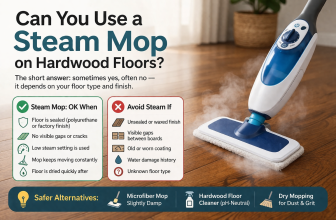
If cloudiness appears after steam use, the mop’s moisture output may be too high for your floor type. We tested the Senmo Steam Mop specifically for hardwood haze — it’s one of the few models with genuinely controlled low steam.
When Cloudiness Is Actually Finish Breakdown
Sometimes haze doesn’t improve.
If you notice:
- Permanent dull traffic lanes
- Scratch webbing in sunlight
- No improvement after distilled rinse
The issue may be finish degradation. Finish breakdown is uneven and location-specific. Residue haze is usually uniform. Some films don’t just look cloudy — they also feel slightly tacky. This breakdown of what causes that tacky residue can help.
How to Fix Cloudy Floors Safely
1️⃣ Rinse with distilled water
Removes mineral interference.
2️⃣ Reduce cleaner concentration
Most haze is caused by too much product.
3️⃣ Use clean microfiber
Old pads redistribute film.
4️⃣ Improve airflow
Even drying prevents mineral concentration.
5️⃣ Buff dry immediately
Dry microfiber restores clarity fast.
6️⃣ Avoid layering shine products
Gloss enhancers often create long-term haze.
If residue keeps returning regardless of technique, switching to a steam mop eliminates the cleaner buildup problem entirely — no product, no residue. [Best steam mops for hardwood floors →]
Preventing Cloudiness Long-Term
✔ Use less product
✔ Wring mop thoroughly
✔ Avoid mixing cleaners
✔ Don’t recoat without removing old film
✔ Ensure drying under 45 minutes
Cloudiness is usually a process issue — not a floor failure.
FAQ
Why do my hardwood floors look cloudy after mopping?
Most commonly from cleaner buildup or hard water minerals left behind after evaporation. When water dries, dissolved substances stay on the surface and scatter light unevenly — creating a haze that wasn’t there before cleaning.
Why do floors look clear when wet but cloudy when dry?
Because water temporarily fills micro-scratches and evens out light reflection. When it dries, residue and minerals remain and scatter light. If your floor looks clear while damp but hazy once dry, it’s almost always a residue issue — not damage.
Can too much cleaner cause cloudy floors?
Yes — overuse of cleaning product is one of the top causes of cloudy floors. Even small over-concentration builds up over time. The surfactants and polymers in cleaner stay behind after water evaporates and form a film that mutes reflection.
Is a cloudy floor permanent?
In most cases, no. Film haze from cleaner buildup or hard water is reversible. A distilled water rinse followed by dry microfiber buffing often clears it up after one cycle. Only finish wear or structural damage creates permanent cloudiness.
How do I fix cloudy floors after mopping?
Rinse with distilled water, reduce cleaner concentration, use a clean microfiber pad, and improve airflow while drying. Buff dry immediately after rinsing. Most cloudy floors clear up after one proper rinse cycle with less product.
Final Thoughts
Why floors get cloudy after mopping isn’t complicated. Water leaves. Solids stay. Cloudiness is almost always a reflection problem — not a structural one.
When you control:
- Water volume
- Cleaner concentration
- Drying speed
You control clarity. Most cloudy floors don’t need refinishing. They need adjustment.