
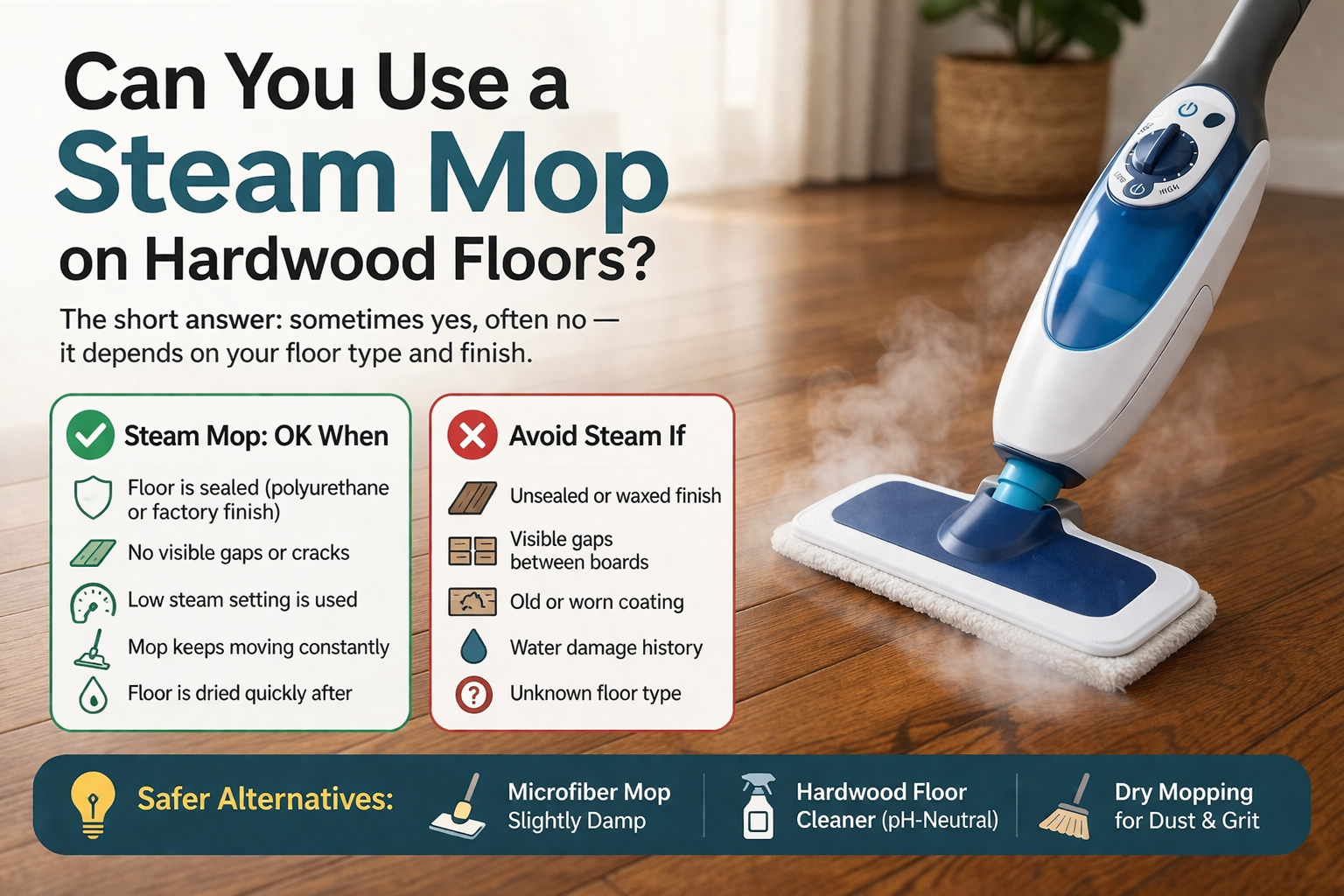
Can you use a steam mop on hardwood floors? The short answer is: sometimes yes, often no — and it depends entirely on your floor type and finish.
Steam mops promise an easier, chemical-free way to clean floors. But hardwood is one of the most moisture-sensitive surfaces in your home. Get it wrong, and you risk warping, swelling, or permanently dulling the finish.
This guide covers when steam is safe on hardwood, when it isn’t, and what to use instead.
The problem: not all hardwood floors are the same
Most people assume “hardwood” is one category. It isn’t. There are three main types, and they behave very differently with steam.
Solid hardwood is milled from a single piece of wood. It expands and contracts with moisture changes, has no protective composite layer underneath, and is the most vulnerable to steam damage. Steam mops are not recommended for solid hardwood — even small amounts of moisture can seep into micro-gaps between boards over time.
Engineered hardwood has a real wood veneer on top and a plywood or composite base. The base layers are more dimensionally stable than solid wood, making engineered hardwood somewhat more resistant to moisture. Steam can be used on engineered hardwood — but only if the floor is fully sealed and the manufacturer explicitly allows it.
Prefinished hardwood comes from the factory with a polyurethane or aluminum oxide coating. This finish is harder and more moisture-resistant than site-finished floors. It’s the most steam-compatible type of hardwood, but still requires caution.
The rule of thumb: if you’re not sure which type you have, treat it as solid hardwood and avoid steam.
For vinyl plank floors, the rules are different — see our guide on using a steam mop on vinyl plank flooring.
When Is a Steam Mop Safe on Hardwood Floors?
Steam can be used safely on hardwood, but only when all of the following are true:
- The floor is sealed with polyurethane or a factory finish in good condition
- There are no visible gaps, cracks, or worn areas
- The manufacturer hasn’t specifically warned against steam cleaning
- You use the lowest steam setting available
- You keep the mop head moving constantly — never pause in one spot
- You work in small sections and let each area dry before moving on
If even one of these conditions isn’t met, the risk of damage increases significantly.
When You Should NOT Use a Steam Mop on Hardwood Floors
Avoid steam completely if your floor has any of the following:
- Unsealed or waxed finish (steam breaks down wax and can penetrate bare wood)
- Visible gaps between boards (steam forces moisture into the subfloor)
- An old or worn coating (even small worn patches become entry points for moisture)
- A history of water damage or warping
- An unknown finish — common in older homes or rental properties
Cleaning experts recommend avoiding steam on hardwood entirely, noting that “steam can sneak in and cause warping and damage the floors” — particularly on unsealed surfaces where “the pressure can force moisture into the material, leading to warping or mold growth inside the subfloor.”
What Can Go Wrong
The damage from steam on hardwood doesn’t always appear immediately. Sometimes it takes weeks. Here’s what to watch for:
Cupping — the edges of boards rise higher than the center. Caused by moisture absorbing unevenly from the bottom of the board.
Warping — boards bend, twist, or distort. Often irreversible without replacing the affected boards.
Swelling — boards expand and press against each other, creating raised ridges or gaps when they dry out.
Finish damage — the surface becomes dull, cloudy, or develops white haze marks. Common when steam is too hot or applied too slowly.
How To Safely Steam Clean Hardwood (if Your Floor Qualifies)
If your floor meets all the safe criteria above, follow these steps:
Use the lowest steam setting. More steam means more moisture and more risk. Many steam mops have three settings — always start at the lowest and only increase if needed for stubborn spots on tile or other non-wood surfaces.
Use a soft microfiber pad. Avoid textured or scrubbing pads on hardwood. You want maximum absorption and minimal friction.
Keep moving. Never let the steam mop sit still on hardwood. Even two to three seconds in one spot can cause localized moisture buildup.
Work in sections. Clean a 3–4 foot area, move forward, and let it dry before going back over the same spot.
Dry immediately if needed. If the floor feels damp after a pass, wipe it with a clean dry cloth. Hardwood should feel dry within 15–30 seconds of steaming.
Best Steam Mop for Hardwood Floors (Safe Picks)
If your hardwood floors are fully sealed and the manufacturer does not warn against steam, these are the three models I’d look at first. The most important feature here is controlled steam output. Hardwood does not respond well to excess moisture, so gentler steam is usually the safer choice.
Editor’s Choice: Bissell PowerFresh 1940A
Best overall for hardwood floors thanks to its adjustable steam settings, fast heat-up time, and soft microfiber pads. It gives you better control than basic one-mode steam mops, which matters when you’re cleaning sensitive wood surfaces.
Best Lightweight Pick: Shark S3501 Steam Pocket Mop
A simple, lightweight option for smaller spaces and lighter messes. Easy to maneuver and less bulky than many full-size steam mops.
Best Compact Pick: Bissell PowerFresh Slim
A good fit if you want something more compact and easier to store, with a gentler low-steam option for sealed hardwood.
Best Steam Mops for Hardwood Floors
| Model | Why It’s Good for Hardwood | Key Features | |
|---|---|---|---|
| Bissell PowerFresh 1940A | Precise steam control helps avoid excess moisture that can damage wood | Digital low / medium / high steam settings, heats in 30 sec, dual microfiber pads | Check price on Amazon |
| Shark S3501 Steam Pocket Mop | Lightweight and easy to control, ideal for gentle, everyday cleaning | Under 5 lbs, 450ml tank, 30 sec heat-up, on-demand steam | Check price on Amazon |
| Bissell PowerFresh Slim | Best for delicate hardwood due to low moisture output | Compact design, low-steam mode, converts to handheld | Check price on Amazon |
What to Avoid
- Heavy-duty commercial steam cleaners
- Handheld steam blasters (too much pressure and heat)
These can easily over-saturate wood and cause long-term damage.
Looking for a full review? Read our Bissell PowerFresh steam mop review for a detailed breakdown.
Safer Alternatives if Steam Isn’t Right for Your Floors
If you’re unsure about your floor type or finish, these options are safer and still effective:
Microfiber mop with a lightly damp cloth — wring out almost completely before using. The floor should feel barely damp, not wet. Safe for all sealed hardwood types.
Hardwood-specific floor cleaners — pH-neutral formulas like Bona Hardwood Floor Cleaner are designed not to penetrate or damage wood finishes. Spray on a microfiber pad, not directly on the floor.
Dry mopping — for everyday maintenance, a dry microfiber mop removes dust, grit, and debris without any moisture risk. This is the safest daily option.
FAQ
Can I use a steam mop on engineered hardwood?
Yes, in some cases. Engineered hardwood is more stable than solid wood, but you still need a fully sealed floor, the lowest steam setting, and manufacturer approval. When in doubt, use a damp microfiber mop instead.
Will a steam mop warp hardwood floors?
It can, especially if the floor isn’t sealed, the steam setting is too high, or you move too slowly. The risk is higher with solid hardwood than with engineered or prefinished floors.
How often can you steam clean hardwood floors?
Rarely — at most once or twice a month, and only if your floor passes all the safe criteria above. For weekly maintenance, use a dry microfiber mop or a barely damp cloth.
Is a steam mop better than a regular mop for hardwood?
For hardwood specifically, no. Less moisture is always better for wood floors. A quality microfiber mop with minimal moisture is a safer choice for routine cleaning.
Can I use a Bissell steam mop on hardwood floors?
Bissell’s PowerFresh line includes adjustable steam settings that make it one of the safer options for sealed hardwood. Use only the lowest setting and keep the mop moving. Check your specific floor’s manufacturer guidelines before using any steam mop.
The bottom line
Steam and hardwood can coexist — but only under specific conditions. If your floors are sealed, in good condition, and you use the lowest steam setting, the risk is manageable. If you have solid hardwood, gaps between boards, or an older unknown finish, skip the steam entirely and use a damp microfiber mop instead.
The cost of a damaged hardwood floor far outweighs the convenience of steam cleaning.